Whether Claude Max, ChatGPT Pro, or a higher Cursor tier is worth it depends on three numbers from your own last month: how often you hit your plan’s limit, what your usage would have cost at API prices, and what that usage shipped. Upgrade when you are blocked most weeks and the work you ship justifies the difference. Otherwise stay where you are, and if you never come near the limit, consider moving down.
Most comparisons of these plans argue from the price table, and they contradict each other, because the thing that matters, how much work each tier allows, is not published in a form you can compare. Your own usage is the only reliable evidence, and collecting it is not much work.
A disclosure: we make LobsterOne, one of the tools that produces these numbers. Everything below can also be done with free tools, and the steps say how. Prices were read from each vendor’s pricing page on November 18, 2026.
The Prices, for Reference
| Vendor | Entry | Middle | Top |
|---|---|---|---|
| Claude (includes Claude Code) | Pro $20 | Max $100 | Ultra $200 |
| ChatGPT (includes Codex) | Plus $20 | Pro $100 | Pro $200 and $500 |
| Cursor | Plus $8, Premium $30 | Super $100 | Ultra $200 |
| GitHub Copilot | Pro $10 | Pro+ $39 | Max $100 |
Monthly billing, in USD. Two notes on names. Claude’s $200 tier is listed as Ultra on Anthropic’s pricing page today, though many articles still call both upper tiers Max. And each Cursor tier includes a different set of models, so check what a tier covers before comparing it to a Claude or ChatGPT plan at the same price.
These change often. Treat this table as a snapshot and check the vendor’s page before you pay.
Why the Price Table Does Not Answer the Question
A $100 plan is not five times a $20 plan in any way you can verify from the outside. Limits are expressed as rolling windows, vary by model, and can change. Two developers on the same plan can have opposite experiences: one never notices the limit, the other is locked out by lunchtime, because one writes short prompts against a small repository and the other runs long agent sessions over a large one.
So the question is not which plan is the best value in general. It is whether your current plan is the constraint on your work.
Number 1: How Often Do You Hit the Limit?
This is the only number that tells you whether an upgrade would change anything.
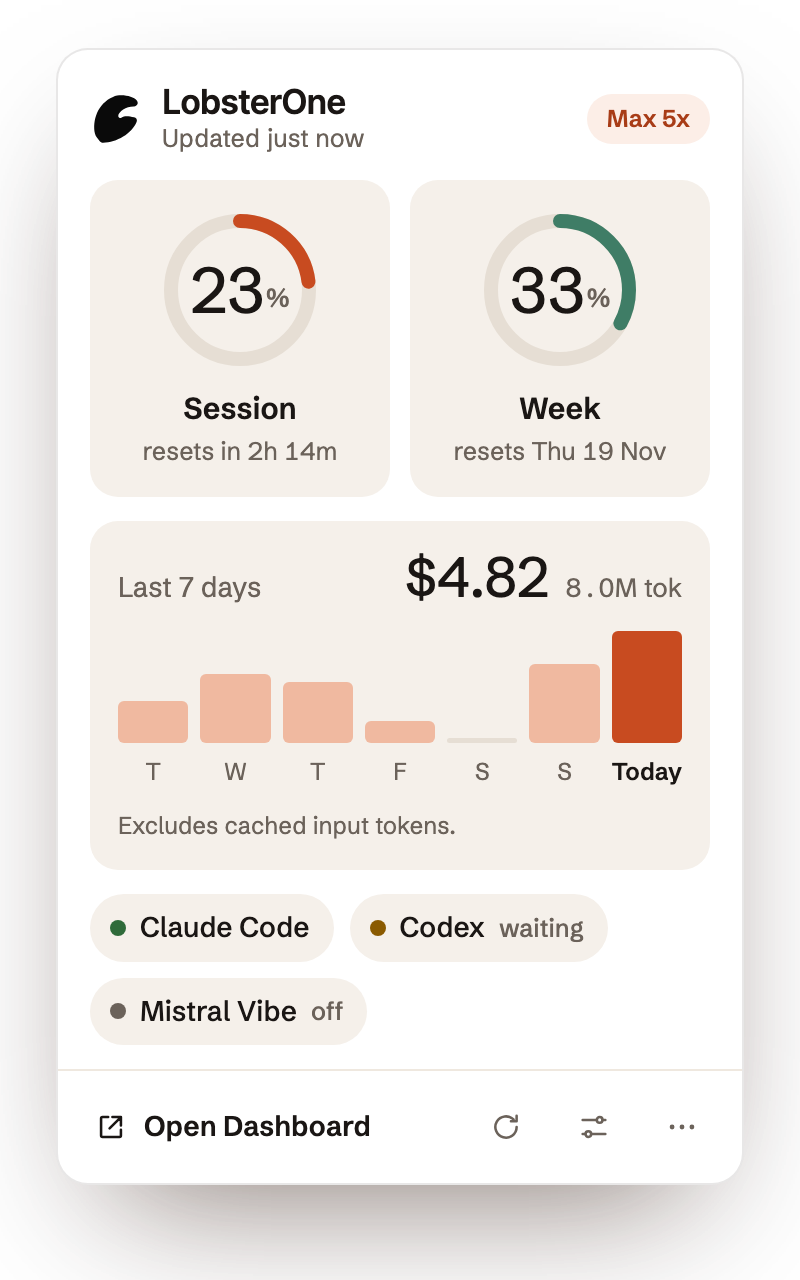
For two weeks, note each day you are blocked or slowed by a limit. In Claude Code, /usage shows how much of your session and weekly windows you have used; Codex has /status. A menu bar tracker makes this effortless because the percentage is always visible. We compared those in the best Mac menu bar apps for AI coding.
How to read it:
- Never or once: your plan is not the constraint. Do not upgrade.
- A few times, late in the day: borderline. Look at the next two numbers.
- Most working days: the limit is costing you time. An upgrade is likely to pay.
Number 2: What Was Your Usage Worth?
On a flat plan the bill never moves, so the useful comparison is what the same usage would have cost at pay-as-you-go API prices. That tells you whether the plan is a bargain or a waste at your level of use.
The free way to get it is ccusage, which reads the logs your tools already write:
npx ccusage@latest monthlyIt reports tokens and estimated cost by month across the agents it detects, including Claude Code and Codex. Two cautions. The figure is an estimate from published list prices, not an invoice. And it is an upper bound on value, not a measure of it: usage being worth $400 at API rates does not mean you got $400 of work.
How to read it:
- Well below your plan price: you are overpaying. Consider the tier below.
- Roughly equal: the plan is fair. Stay.
- Several times your plan price: you are getting a good deal, and probably close to the limit. Check number 1.
Number 3: What Did It Ship?
The first two numbers are about consumption. The third is about output, and it is the one that justifies spending more.
Count the pull requests you merged in the same month:
gh pr list --author "@me" --state merged --search "merged:>=2026-10-18"Divide the plan price by that count for a rough cost per merged pull request. This is crude; pull requests differ in size, and not all of them involved an agent. But watched over a few months, the trend is informative. If you double your plan and your output does not move, the limit was not what held you back.
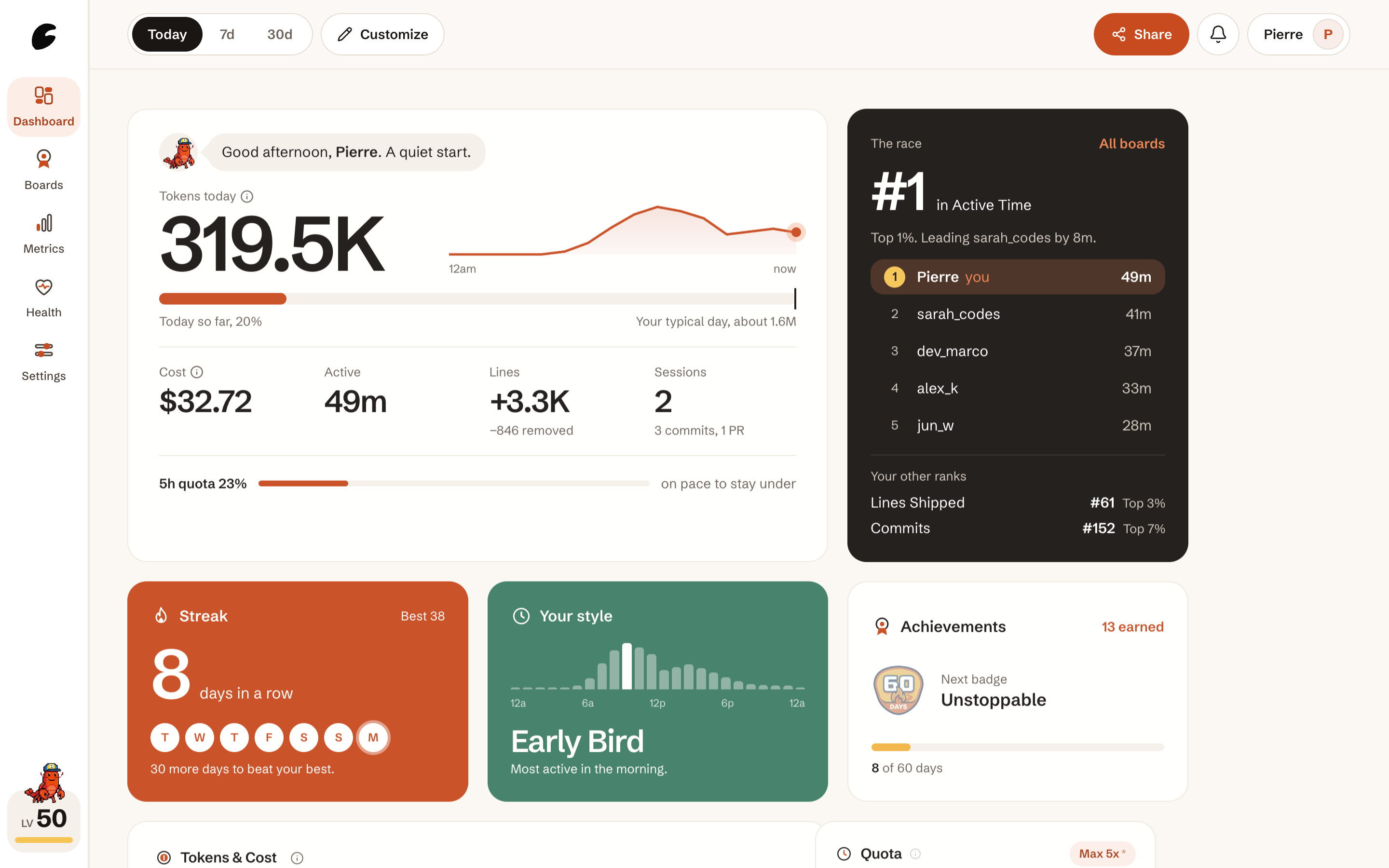
LobsterOne does this calculation continuously, showing cost per pull request and per line for Claude Code, Codex, and Mistral Vibe, and is free for individuals. The by-hand version above gets you the same answer once a month. For a fuller treatment of the arithmetic, see how to calculate AI coding ROI.
Two Worked Examples
These use illustrative numbers, not data from real users, to show how the three figures combine.
A case for upgrading. A developer on a $20 plan hits the session limit on nine of the last ten working days and loses about an hour each time waiting for the reset. ccusage estimates the month at $310 of API-equivalent usage. They merged 24 pull requests. The limit is plainly the constraint, the plan is already delivering far more than it costs, and ten lost hours a month is worth more than the $80 difference. Move to the $100 tier.
A case for downgrading. A developer on a $200 plan has not seen a limit warning in a month. ccusage estimates $140 of API-equivalent usage. They merged 18 pull requests. Nothing about their work depends on the top tier. The $100 tier would cover the same usage with room to spare, and the saving is $1,200 a year.
Most people who run these numbers find they are in neither case, and the right decision is to change nothing. That is a useful result too.
Do You Need Two Subscriptions?
Often, yes, but not two of the same kind. An editor plan and an agent plan do different jobs: one for the work you stay inside, one for the tasks you hand off. Paying for both a Cursor tier and a Claude or ChatGPT plan is common and reasonable.
What rarely makes sense is paying for the top tier of both at once. Run the three numbers for each subscription separately. It is usual to find that one of them is doing nearly all the work.
Check Again Next Quarter
Prices, limits, and your own habits all move. A plan that was the right size in the summer may be too small after you start running agents in parallel, or too large after a vendor raises the limits on the tier below. Put a reminder in your calendar to rerun the three numbers every three months. It is a small job that can save or justify a four-figure annual spend.
For the tools that make collecting these numbers automatic, see the best AI coding usage trackers.
Track these metrics automatically with LobsterOne
Get started freeThe plan is not the goal. The goal is that a limit never interrupts work that matters, and that you are not paying for capacity you do not use. Your own month of data settles both.